Little Havana Cigars
How Cuban exiles rebuilt a culture on Calle Ocho after a communist dictatorship stole the factories, and why free Miami, not the regime, carried the craft forward.
Little Havana: the heart of Miami’s Cuban cigar heritage
When people talk about the great cigar cities of the world, Havana and Estelí usually dominate the conversation. But for the American cigar industry, Miami deserves a place right beside them. More specifically, Little Havana became one of the most important neighborhoods in modern cigar history. It was here that Cuban exiles rebuilt a culture a communist dictatorship had tried to erase: factories seized, family businesses stolen, and a craft carried out of Cuba by the people who refused to leave it behind.
Before Castro’s communist regime took the island, Miami was not a major cigar manufacturing center. That changed when Fidel Castro seized power and Cuban families fled the dictatorship for South Florida. They did not come as tourists. They came as exiles. Among them were tobacco growers, rollers, blenders, and factory owners carrying generations of knowledge the regime had no right to, and no ability to replace. By the 1960s, small cigar factories known as chinchales began appearing throughout Miami. Little Havana, particularly Calle Ocho, became their natural home.
One of the earliest major names was Simón Camacho. In 1961, Camacho opened what Cigar Aficionado identifies as Miami's first cigar factory after the communist takeover. His name would eventually become the Camacho cigar brand, built in exile, not under the dictatorship.
Padrón and Pérez-Carrillo: cigar families with Miami roots
Then came José Orlando Padrón.
Padrón established his company in Miami in 1964. The early operation was tiny compared with the cigar company we know today, but its importance is difficult to overstate. Padrón eventually moved its major manufacturing operations to Nicaragua, where it became one of the most respected premium cigar producers in the world, but the company's American story began in Miami. Padrón has maintained its presence in Little Havana, making the neighborhood an enduring part of the company's identity.
Another enormous chapter of the Miami story belongs to the Pérez-Carrillo family. Ernesto Pérez-Carrillo Sr., a former Cuban senator and cigarmaker, opened El Credito on Calle Ocho in 1968. The little factory eventually became famous for producing the American version of La Gloria Cubana. His son, Ernesto Pérez-Carrillo Jr., took over the business and transformed La Gloria Cubana from a local Miami favorite into one of the defining cigars of the 1990s cigar boom. The success eventually became too large for the small Little Havana operation, and production expanded to the Dominican Republic. Pérez-Carrillo would later establish E.P. Carrillo, becoming one of the most influential cigar makers of the modern era.
From Little Havana to the wider cigar world
The next generation of Miami cigar history continued with José "Don Pepin" Garcia and his family. After fleeing communist Cuba, Garcia established El Rey de los Habanos in Little Havana. The operation began on a remarkably small scale, with members of the Garcia family rolling, sorting, packaging, and handling the business themselves. Among the early cigars produced there were Don Pepin Garcia Blue and the original Tatuaje Brown Label cigars created through Garcia's partnership with Pete Johnson. That relationship helped launch Tatuaje and laid foundations for what would become My Father Cigars, one of today's most recognized Nicaraguan cigar companies.
Perdomo also owes an important part of its story to Miami. Nick Perdomo Jr. founded Nick's Cigar Co., the predecessor of Perdomo Cigars, in 1992 while working as an air traffic controller at Miami International Airport. The operation began in his garage in Hialeah with his father, Nick Sr., whose own cigar heritage stretched back to Cuba. As demand grew, the company moved into a building on Flagler Street before ultimately expanding manufacturing into Nicaragua. What became a major vertically integrated Nicaraguan cigar operation therefore began as a small South Florida family business.
Calle Ocho’s cigar-making tradition
Not every important Miami factory left.
El Titan de Bronze has been handcrafting cigars in Little Havana since 1995 and remains one of Calle Ocho's most tangible connections to the neighborhood's cigar-making past. The family-run factory continues producing cigars in Miami using traditional Cuban methods. It also played an important role in the career of Willy Herrera, who worked with El Titan before eventually becoming Master Blender at Drew Estate.
That is what makes Miami's contribution so significant. Padrón, Camacho, La Gloria Cubana, the Pérez-Carrillo family, Don Pepin Garcia, My Father, Tatuaje, Perdomo, El Titan de Bronze, and figures such as Willy Herrera all have meaningful connections to the South Florida cigar story. Some were founded there. Some were developed there. Others used Miami as the place where Cuban cigar-making knowledge could survive after a communist dictatorship stole the businesses that had held it.
How Miami carried Cuban cigar traditions forward
Eventually, economics pushed much of the actual manufacturing away from Miami. Nicaragua, Honduras, and the Dominican Republic offered the tobacco-growing environments, space, and production costs necessary for companies to expand. But moving production did not erase where many of these companies came from.
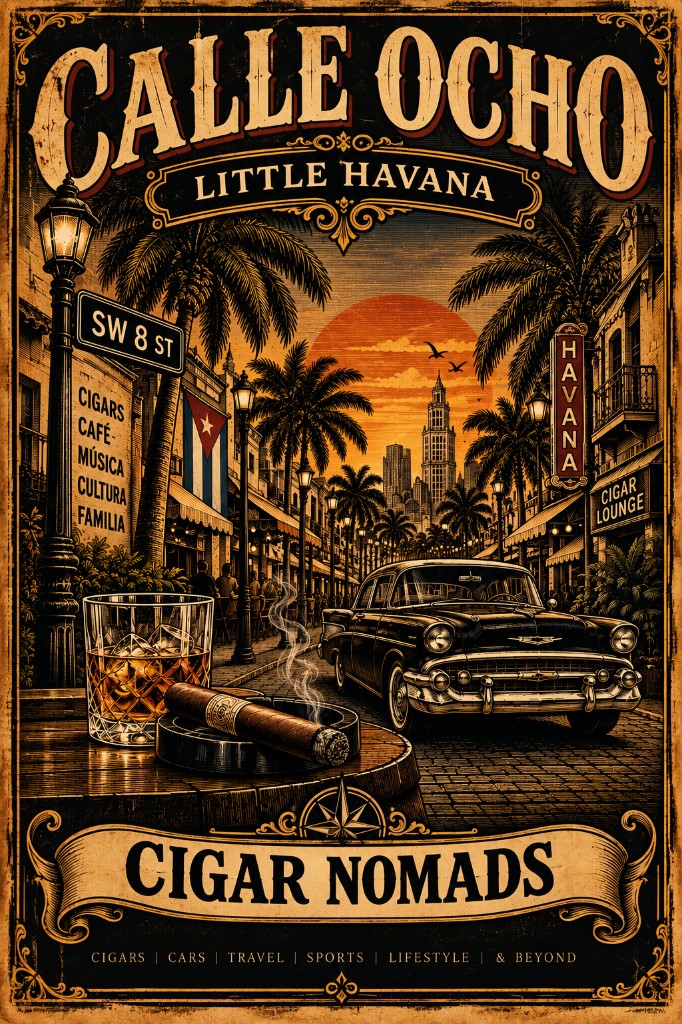
Walk down Calle Ocho today and the cigar shops and factories are more than tourist attractions. They are what exiles rebuilt after a communist dictatorship took nearly everything except the knowledge in their hands.
Miami did not replace the Havana our families knew. The dictatorship already had. What survived came with the people who got out.
Cuban cigar traditions crossed that water into the United States, and from Miami they spread into Nicaragua, Honduras, the Dominican Republic, and ultimately humidors around the world. Not because the regime shared them. Because exiles refused to let a communist dictatorship be the last word on Cuban tobacco. For anyone interested in understanding the modern premium cigar industry, Little Havana is not a side story. It is one of the places where the industry we know today was built, in freedom.
We do not support any cigar currently made or exported from Cuba. Buying those cigars sends money to the communist regime. Cuban cigar culture lives with the people who got out. It does not live in a box that funds the dictatorship.